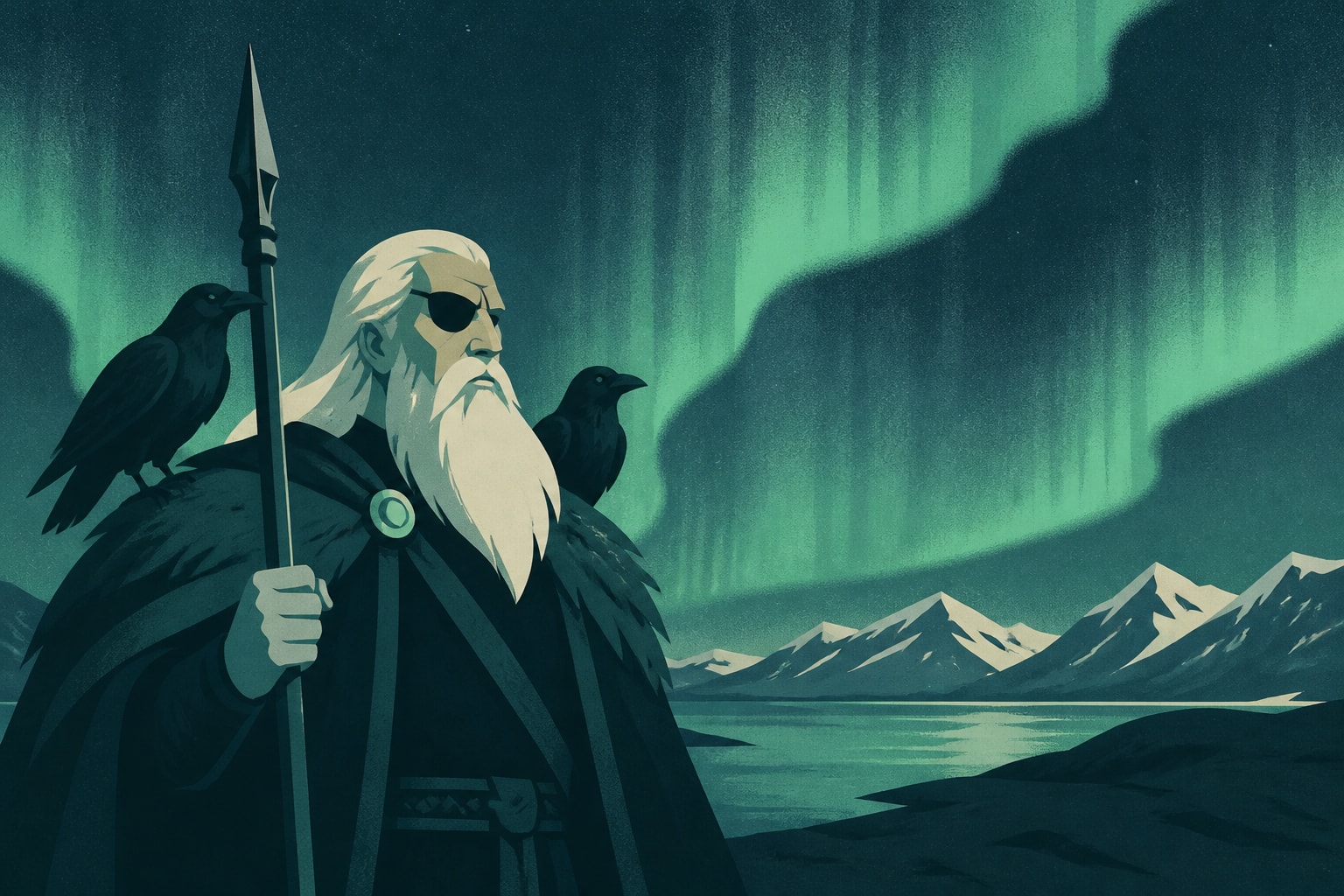
Odin is the chief god of Norse mythology, a one-eyed deity of wisdom, war, poetry, runes and magic who rules over Asgard and receives fallen warriors in Valhalla. Encyclopaedia Britannica describes him as the principal god in Norse mythology and, in later literary sources, as the principal god in Scandinavia near the end of the pre-Christian period. He is also known as Woden in Old English, Wotan in German and the All-Father in the Eddas.
For visitors to Iceland, Odin is more than a figure from a book. The sagas that preserve his stories were written down by Icelanders, and the landscape you travel through on a northern lights evening is the same one that shaped them.
What Is Odin in Norse Mythology?
In Norse mythology, Odin is the leader of the Æsir, the main family of gods, and the ruler of Asgard. He is a god of many domains rather than one: wisdom, war, death, poetry, prophecy, runes and sorcery all belong to him.
The National Museum of Denmark notes that the Norse gods' stories are known through medieval written sources, including Snorri's Edda, the Edda poems and the Icelandic sagas. No Viking Age author left a firsthand account of belief. What survives was recorded in Iceland and elsewhere in the 12th and 13th centuries, after Christianity had arrived.
Odin's character is difficult to pin down. He grants victory and then withdraws it. He seeks knowledge at any cost and is willing to deceive to get it. The World History Encyclopedia describes him in its piece on the contest between Odin and Thor as a complex figure whose wit and knowledge sit alongside less admirable traits.
How Odin Looks and What He Carries
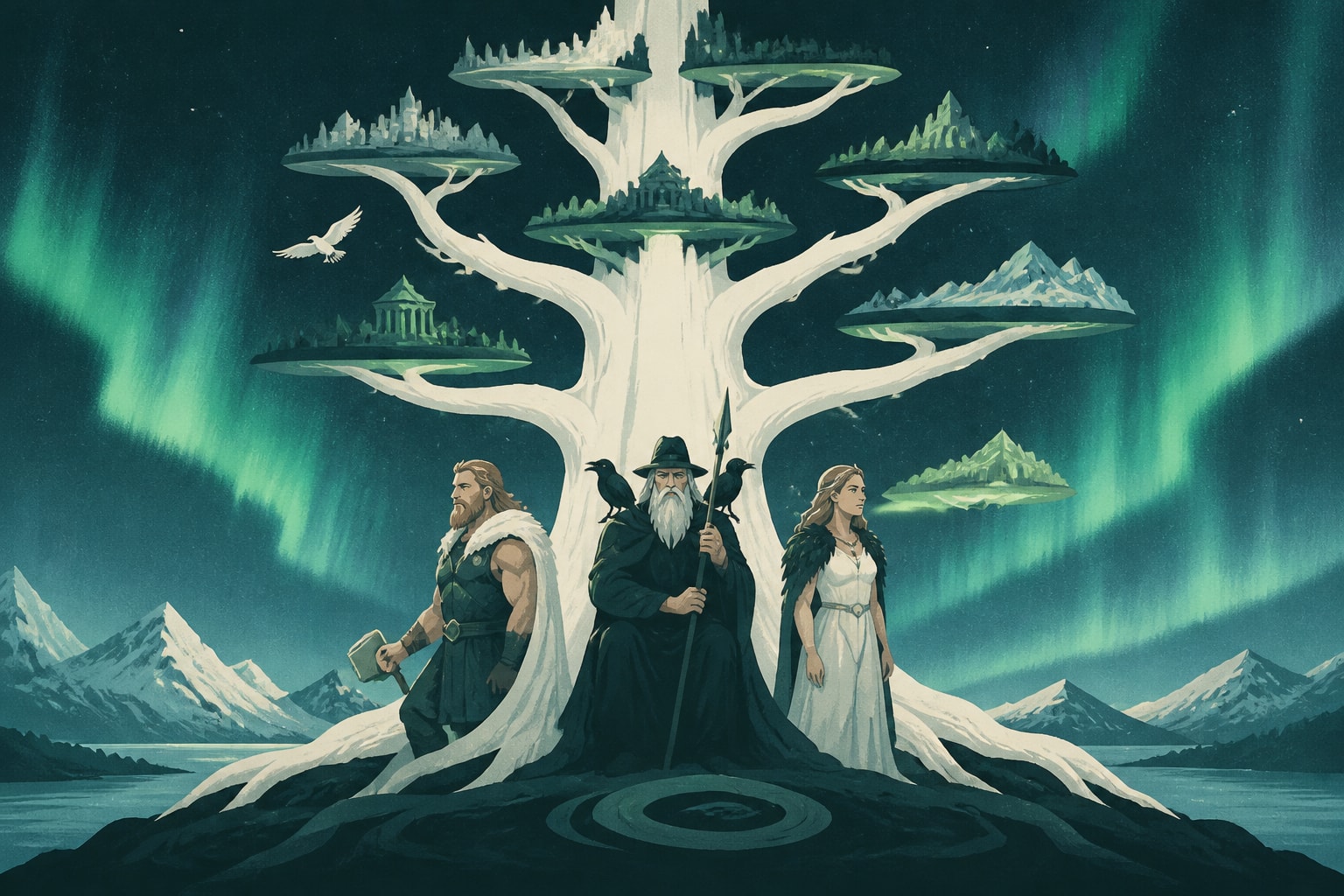
Odin is usually pictured as an older man with a long beard, a wide-brimmed hat or hood, and a single eye. He travels in disguise as a wanderer, which is why many myths begin with an unrecognized stranger arriving at a hall.
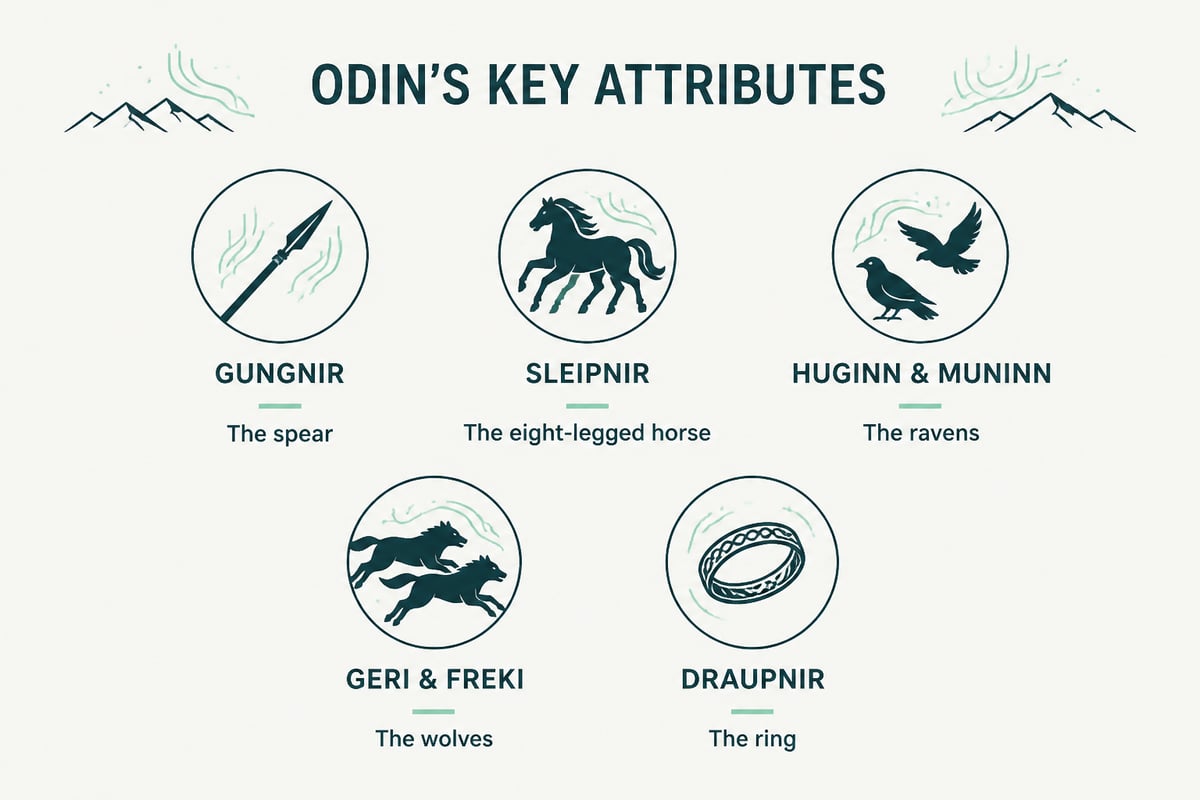
His best-known attributes are easy to list:
- Gungnir: a spear that never misses its target, forged by dwarves.
- Sleipnir: an eight-legged horse that can carry him between worlds.
- Huginn and Muninn: two ravens, Thought and Memory, who fly across the world each day and report back to him.
- Geri and Freki: two wolves that sit at his feet at the feast table.
- Draupnir: a gold ring from which eight new rings drip every ninth night.
The ravens are the detail most visitors remember. They turn Odin into a god who gathers information, which fits his reputation for wisdom better than any weapon does.
Why Is Odin the God of Wisdom?
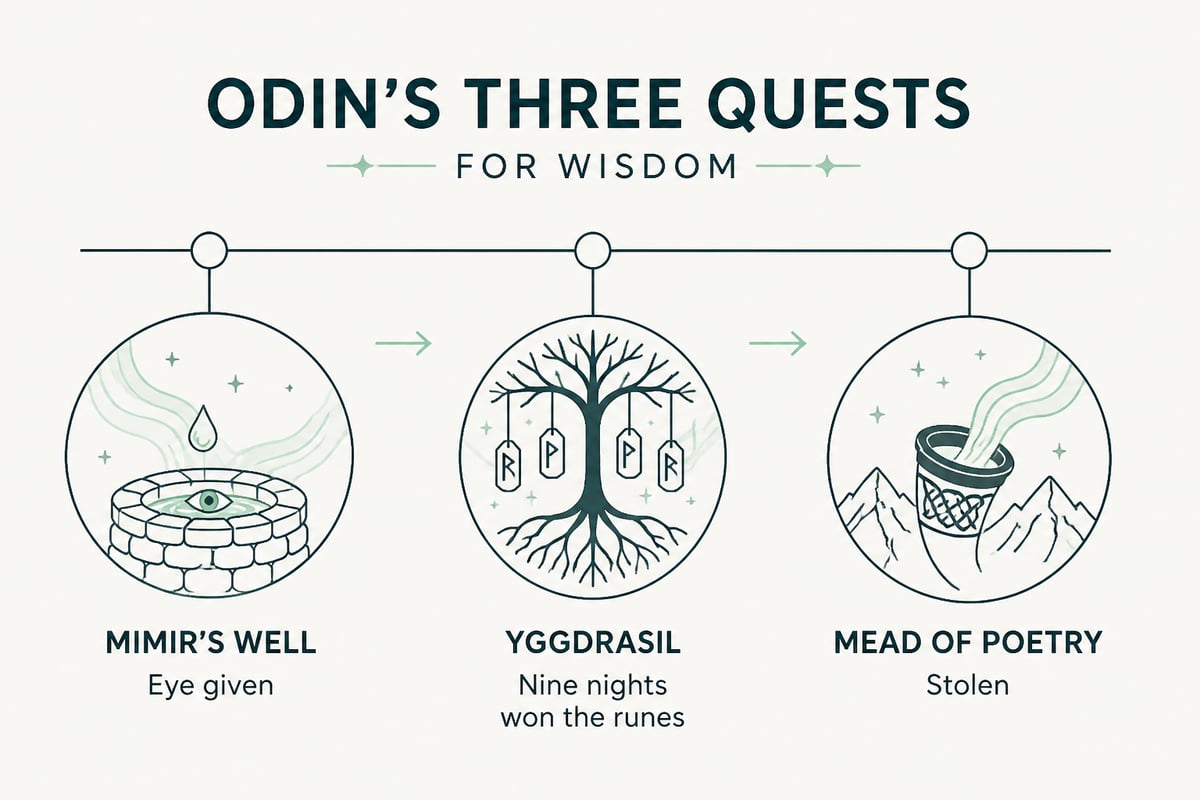
Odin earned his reputation as the god of wisdom by sacrificing parts of himself to gain knowledge. The myths describe two famous trades.
- The eye at Mimir's well. Odin gave up one eye in exchange for a drink from the well of the giant Mimir, which holds knowledge of past and future.
- The nine nights on the tree. He hung himself from the world tree Yggdrasil, pierced by his own spear, for nine nights without food or water. At the end, he saw the runes below, seized them and fell back with their meaning.
The runes were more than letters. In the Norse tradition they carried magical force, and Odin's discovery of them linked him to writing, charms and secret knowledge. The World History Encyclopedia entry on Odin covers these associations with wisdom, runes, poetry, war and magic in detail.
Poetry came to him through a third episode, the theft of the Mead of Poetry from the giants. Anyone who drank it became a poet or a scholar. This is why skalds, the court poets of the Viking Age, treated Odin as their patron.
What Is Odin the God Of?
Odin is the god of wisdom, war, poetry, runes, magic and the dead. Britannica lists the same cluster, noting that fallen warriors were said to join him in Valhalla.
Here is how those domains break down:
| Domain | What it means in the myths |
|---|---|
| Wisdom | Knowledge won through sacrifice at Mimir's well and on Yggdrasil |
| War | Chooses which warriors die in battle and gathers the best for Valhalla |
| Poetry | Brought the Mead of Poetry to gods and humans |
| Runes and magic | Learned the runes and practiced seiðr, a form of sorcery |
| Death | Hosts the slain warriors and leads the Wild Hunt in later folklore |
Valhalla is the hall where chosen warriors feast and fight until Ragnarok, the final battle in which the gods meet their end. Odin's fate in that battle is to be swallowed by the wolf Fenrir. You can read more about that story in our posts on Ragnarok and Fenrir.
Odin's Family and Fellow Gods
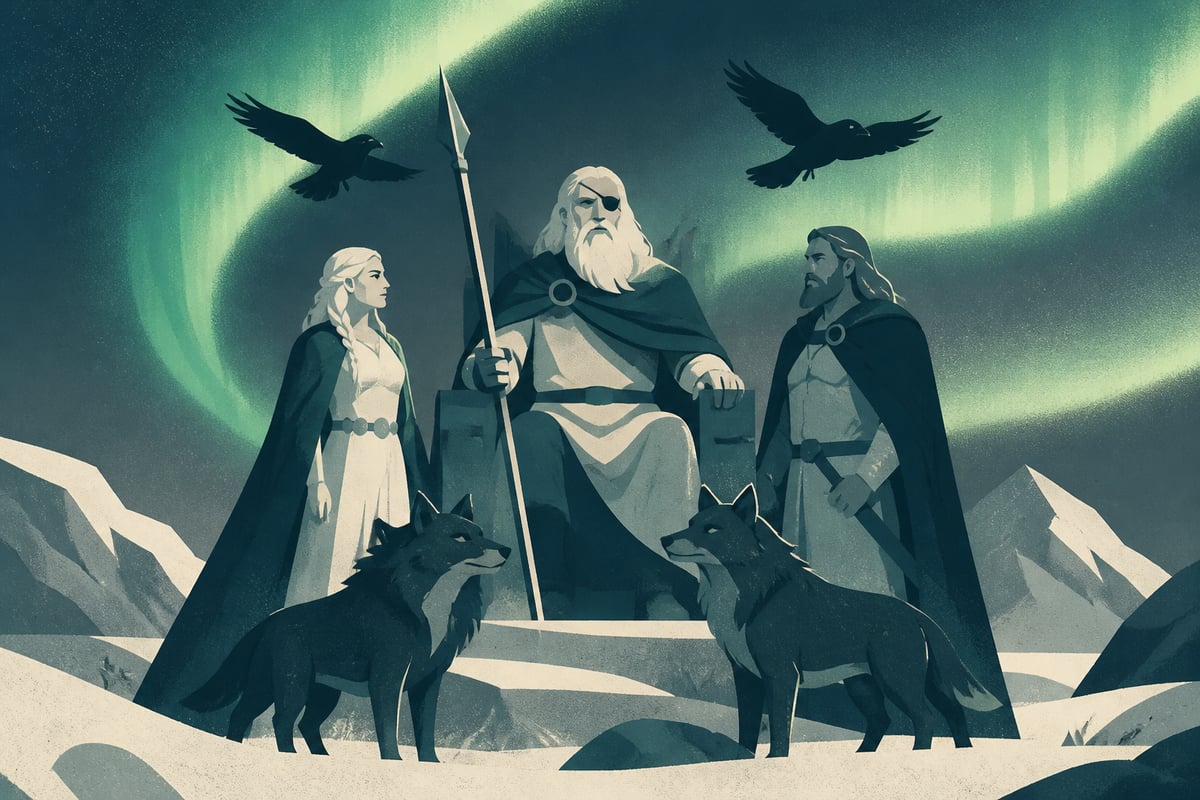
Odin sits at the center of a large divine family. His wife is Frigg, a goddess associated with foresight and marriage. His sons include Thor, the thunder god, and Baldr, whose death is one of the most tragic stories in the Eddas.
Loki, a shape-shifting trickster who is Odin's blood-brother by oath, stirs up much of the trouble the gods face. If you want to meet the rest of the pantheon, our overview of the Norse gods is a good starting point, and we have dedicated posts on Thor and Loki.
Two groups of gods appear in the sources: the Æsir, led by Odin, and the Vanir, associated with fertility and prosperity. The World History Encyclopedia's guide to Norse mythology explains how these two groups fit within the Viking Age worldview.
Who Is Odin in Real Life?
Odin is not a historical person. He is a mythological figure, and no source records a real man who lived as Odin. Some medieval writers, including the Icelandic author Snorri Sturluson, presented the gods as ancient kings who were later worshipped, but this is a medieval interpretation and not evidence of an actual individual.
What does exist is evidence that people worshipped him. Place names across Scandinavia and England carry his name, and Viking Age art shows figures that scholars link to him. The English weekday Wednesday, meaning Woden's day, derives its name from Odin.
Today, Odin also appears in modern religion. Followers of Ásatrú and related Heathen movements honor him as a living deity.
Who Is Stronger, Zeus or Odin?
There is no official answer, because the two gods come from different traditions and were never written into the same story. Zeus rules the sky and the Olympians through raw authority and thunderbolts. Odin is a god who values cunning over strength, and his power comes from knowledge, magic and the loyalty of warriors.
Odin's story also carries a built-in limit that Zeus's does not: he knows he will die at Ragnarok and spends his reign preparing for it. That awareness of doom makes him a more tragic figure than the Greek king of the gods, even if it does not settle a contest of strength.
Why Odin Still Matters
Odin matters because he shaped how Iceland and the wider North understood knowledge, death and fate. His story treats wisdom as something that costs a great deal, and that idea has remained part of Northern European culture for a thousand years.
He also left traces in everyday life. Wednesday carries his name. Modern novels, films and games draw on his image as the one-eyed wanderer. The Eddas that preserve his stories remain central to Icelandic national identity, and many visitors come to Iceland partly to see the places where those texts were written.
Interest in these stories also fits naturally with the aurora. Later folklore connects the Norse gods with the Bifröst, the burning rainbow bridge that links Asgard to the human world, and some visitors like to imagine the northern lights in that spirit. It is a mythological association, not a historical claim, but it adds a layer of meaning to a night under the sky.
Odin and the Northern Lights Evening in Iceland
Odin and the aurora are not linked by any ancient source, but the two make a natural pairing for a visitor's evening in Iceland. The myths give you something to talk about while you wait for the sky to clear, and the dark, quiet countryside outside Reykjavik suits the mood of the stories.
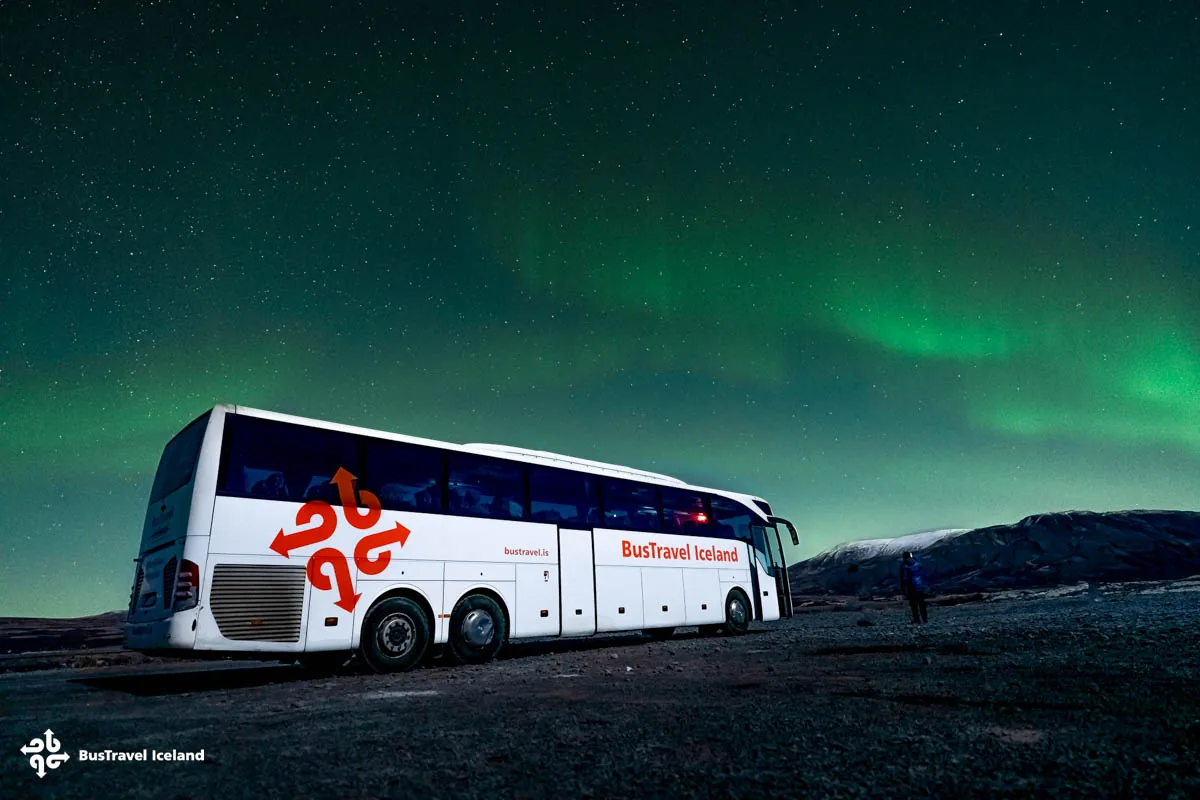
- Coach tour: the larger, more economical option for visitors comparing price.
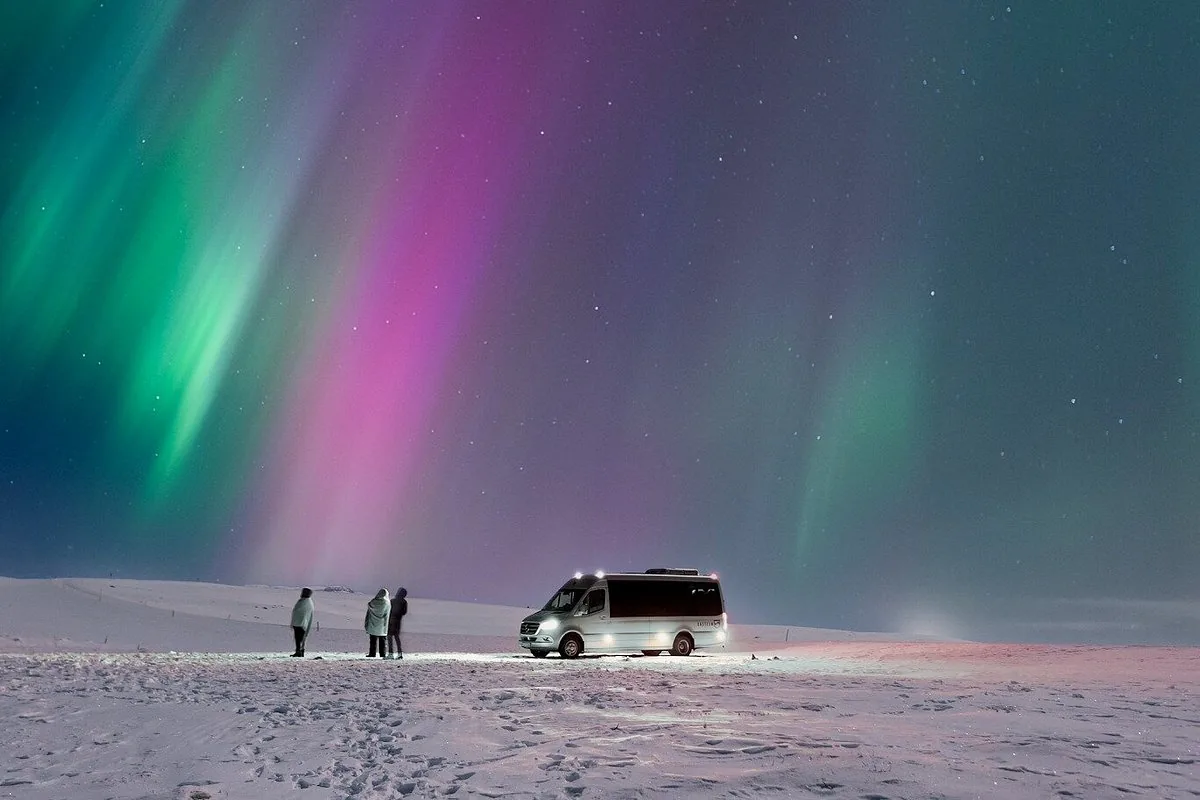
- Minibus tour: a more personal group size.
- Superjeep tour: a vehicle for small groups and couples who want the most intimate evening.
On every tour, local guides plan viewing stops around cloud cover and the aurora forecast. If no lights appear, a retry option may be available depending on the tour. No operator can promise an aurora sighting, since it depends on solar activity and clear skies, so a flexible evening and a second attempt are practical benefits. For current routes, prices and group sizes, check the tour pages directly.
If you prefer a vehicle with more character, here is what to expect from a superjeep in Iceland.
A small group evening suits the Odin theme well. A guide with local knowledge can tell you the stories while you wait, and on a quiet night under a clear sky, the myths of the All-Father feel closer than they do in a museum.
FAQ
Is Odin the same as Woden?
Yes. Woden is the Old English form of Odin's name, and the same god appears as Wotan in German tradition. The weekday Wednesday comes from Woden's day.
What did Odin sacrifice for wisdom?
Odin gave up one eye to drink from Mimir's well, and he hung himself from Yggdrasil for nine nights to learn the runes. Both sacrifices explain his reputation as the seeker of knowledge.
Where do we learn about Odin's stories?
Most of what we know comes from the Poetic Edda, Snorri Sturluson's Prose Edda and the Icelandic sagas, all written in the medieval period. They preserve oral traditions that are much older.