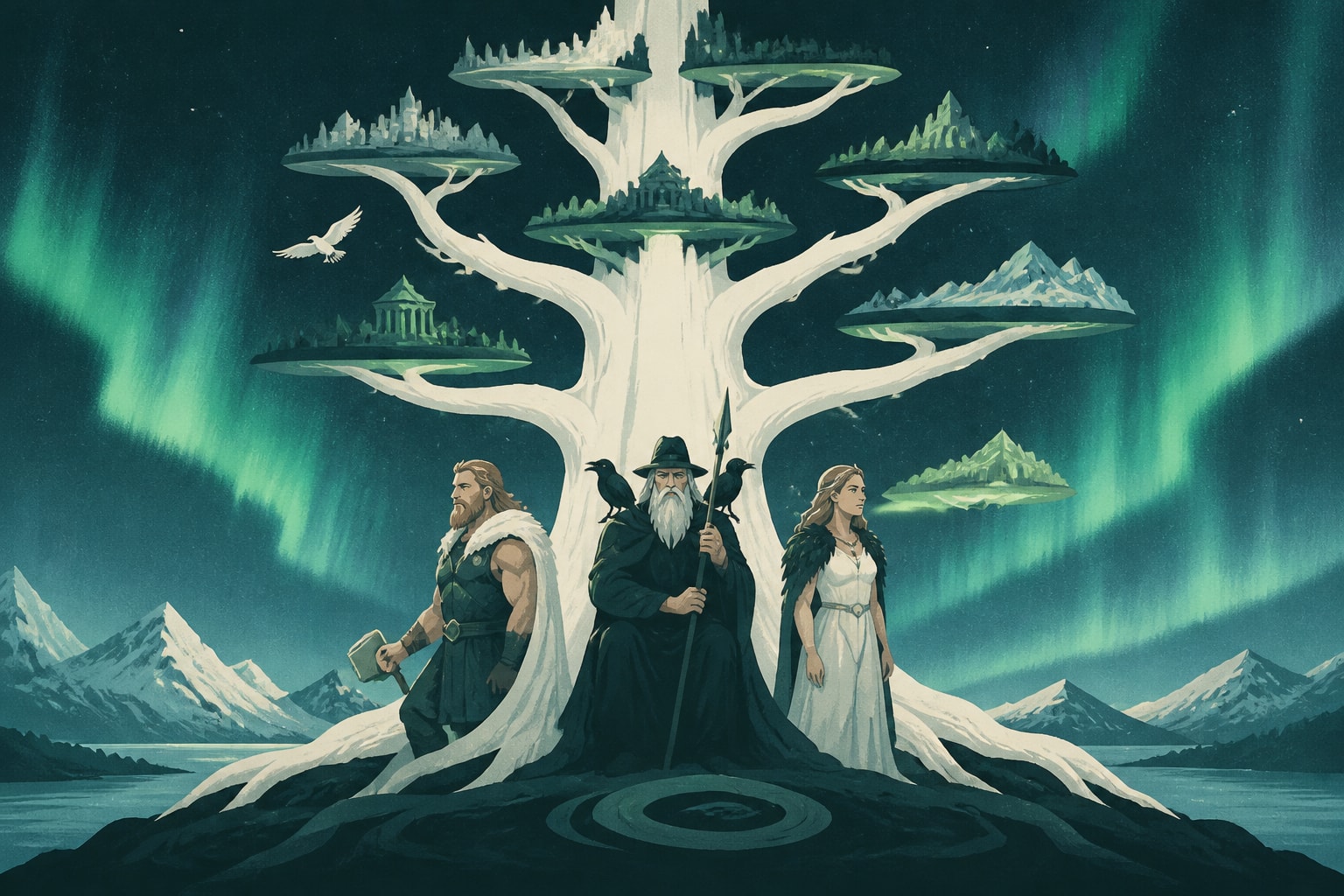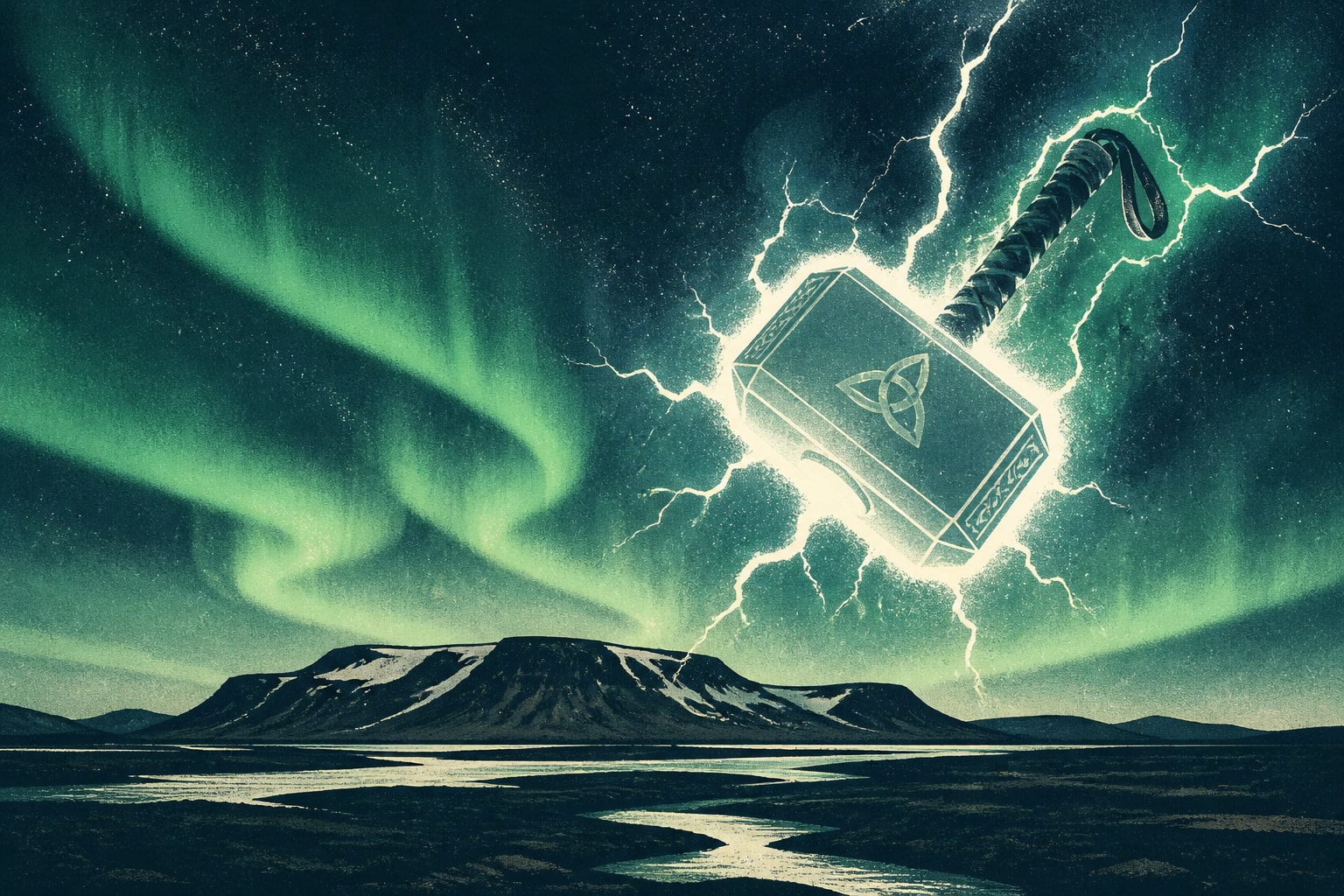
Mjölnir is the hammer of Thor, the Norse god of thunder, and the most famous weapon in Norse mythology. It is a short-handled war hammer that never misses its target, returns to its owner's hand after being thrown, and doubles as a sacred tool for blessing people and things. According to Encyclopaedia Britannica, Mjölnir (also spelled Mjollnir) is a symbol of Thor's power and serves both as a weapon and as an instrument for hallowing.
For visitors in Reykjavik, the hammer is more than a museum curiosity. The Norse stories that give us Mjölnir were written down in Iceland, a land whose skies were watched by the people who preserved these myths.
What Does the Name Mjölnir Mean?
The name Mjölnir is Old Norse, and its exact meaning is debated among scholars. The most common reading connects it to words for "crusher" or "lightning," which fits a weapon tied to a thunder god. Other interpretations link it to a root meaning "to grind" or "to smash," which describes what the hammer does to its enemies.
The spelling varies because the Old Norse "ö" is often written "o" in English, giving Mjolnir, or "oe," giving Mjoelnir. Icelandic uses the original character, and so do most modern references to the myths. All of these forms point to the same object.
How Was Mjölnir Forged?
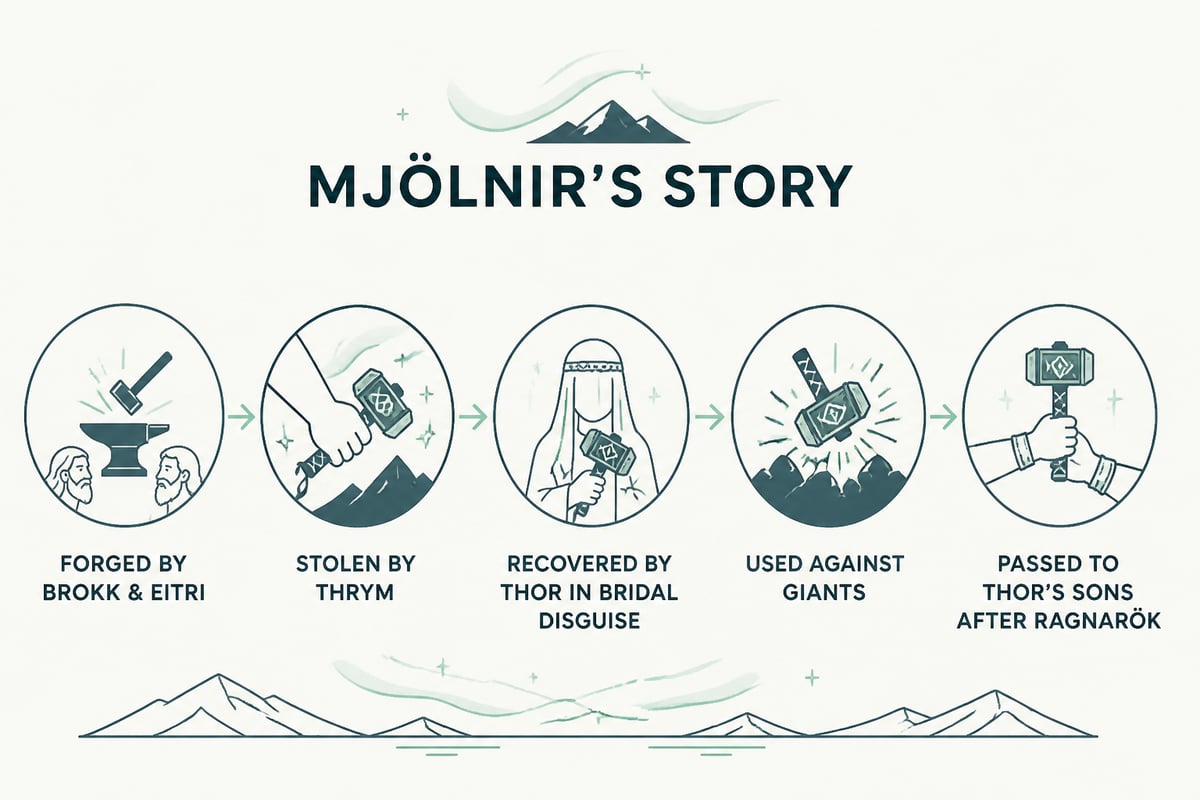
According to the account of Snorri Sturluson, the thirteenth-century Icelandic writer who preserved much of what we know about Norse myth, the dwarfs Brokk and Eitri forged Mjölnir. Britannica's entry on the hammer records this tradition, and it is the version most retellings follow.
The story begins with mischief. The trickster god Loki cut off the golden hair of Thor's wife, Sif, and then had to make amends by commissioning replacement hair from the dwarfs. Their craftsmanship was so fine that Loki wagered his head with Brokk that Eitri's brothers could not match it. The dwarfs went on to make several treasures:
- Golden hair for Sif that grew like living hair
- Skidbladnir, a ship that could be folded small enough to fit in a pocket
- Gungnir, Odin's spear that never misses its mark
- Gullinbursti, a golden boar for the god Freyr
- The ring Draupnir, which produced new rings every ninth night
- Mjölnir, the final and greatest treasure
During the forging of the hammer, Loki took the form of a fly and bit Brokk and Eitri to ruin the work. He managed only to shorten the handle at the last moment. This is the traditional reason Mjölnir has a short haft, a feature also noted in Britannica's overview of Germanic mythology. In the myth, the hammer is the finest of the treasures, since it gave the gods protection against the giants.
What Powers Does Thor's Hammer Have?
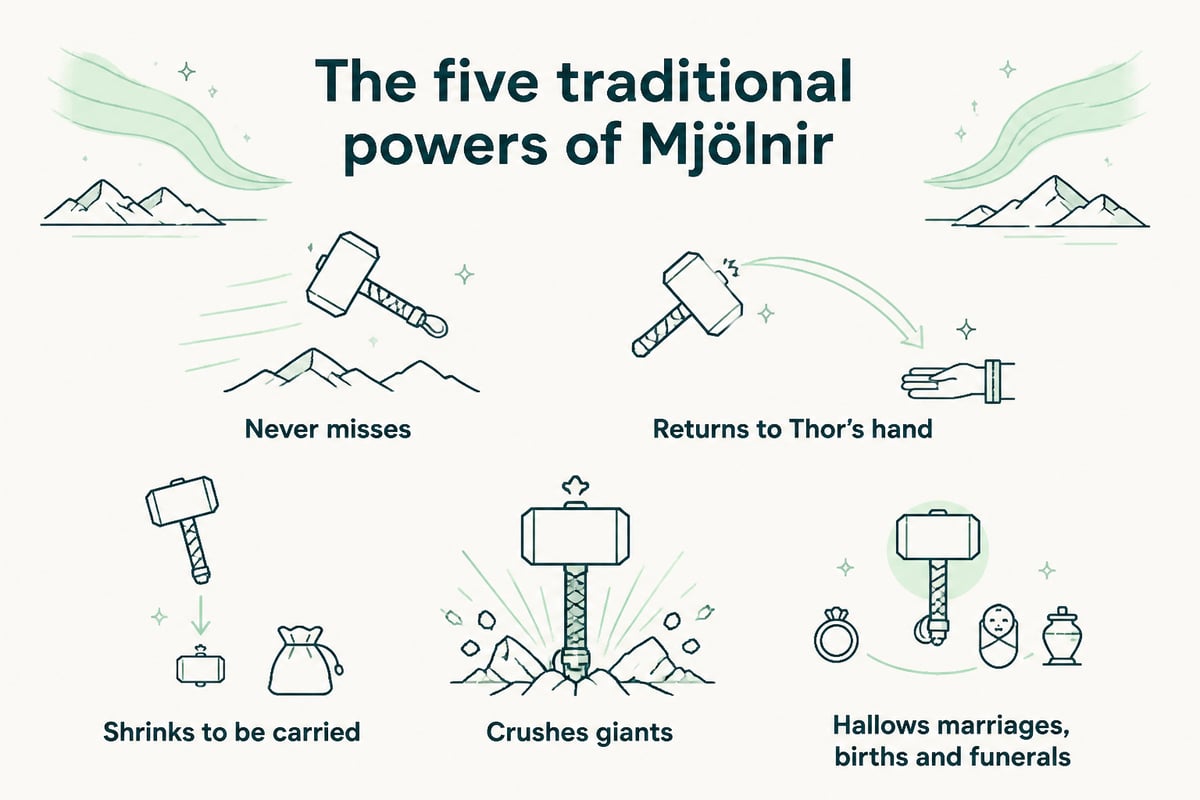
Mjölnir has a set of powers that the myths describe consistently, though no single text lists them all in one place. Together they make it the most reliable weapon among the gods.
- It never misses. Once thrown, it strikes whatever Thor aims at.
- It returns to his hand. After striking, it flies back to the thrower.
- It can be made small. The hammer shrinks enough for Thor to carry it hidden in his clothing.
- It crushes giants. Its primary use in the myths is defending the gods and Midgard (the human world) from the giants.
- It hallows and blesses. In some sources Thor uses the hammer to consecrate marriages and funerals.
To wield it, Thor also needs two items: a belt of strength, which doubles his divine power, and iron gloves, which let him grip the hammer's handle safely. Without the gloves, the myths imply, the heat or force of the weapon would be too much even for him.
The student-friendly account of Mjölnir at Britannica Kids summarizes these traditional associations, including the hammer's use in battle and in ritual.
How Does Mjölnir Return to Thor?
In the myths, Mjölnir returns to Thor's hand after he throws it. The myths do not describe a mechanism such as a leather strap or magic call. The return is simply part of the hammer's nature, like its accuracy.
This matters in the stories because it makes Thor's defense of the gods reliable. A weapon thrown once and lost would leave him exposed, but Mjölnir lets him strike repeatedly. The poetic sources treat the return as a given and focus on the effect: giants fall, and the hammer is again in Thor's grip.
Who Can Lift Mjölnir in Norse Mythology?
In the Norse sources, Thor is the figure who wields Mjölnir in battle, and the myths do not state a rule that others are unworthy to lift it. That idea, in which only a worthy person can raise the hammer, comes largely from modern comics and films rather than from the medieval texts.
What the myths do show is that others struggle with Thor's possessions. In the tale of Thor's visit to the giant Utgard-Loki, even Thor himself fails a series of tricky tests, which are later revealed as illusions. The medieval emphasis is on Thor's strength and the hammer's reliability, not on a moral test of worthiness. If you are reading modern fantasy alongside the myths, it helps to keep these two traditions separate.
What Is the Story of Thrym's Theft?
The best-known myth about Mjölnir is the tale of its theft by the giant Thrym, preserved in the poem Thrymskvida from the Poetic Edda. One morning Thor wakes to find the hammer gone, and Loki borrows the goddess Freyja's feather cloak to fly to the land of the giants and find it.
Thrym admits he has hidden the hammer and demands Freyja's hand in marriage as ransom, as Britannica records. Freyja refuses outright, so the gods devise a plan: Thor disguises himself as the bride and retrieves the hammer.
The wedding feast is the comic center of the poem. Thor, veiled and dressed as the bride, eats and drinks enormous quantities at the feast. Loki, posing as the bridesmaid, explains away the bride's appetite and glaring eyes. When Thrym lays the hammer in the bride's lap to consecrate the marriage, Thor seizes it and destroys the giant and his guests.
The story shows two sides of Mjölnir. It is a weapon the giants want to hold hostage, and it is also a ritual object used to bless a wedding.
How Was Mjölnir Used in Ritual and Daily Life?
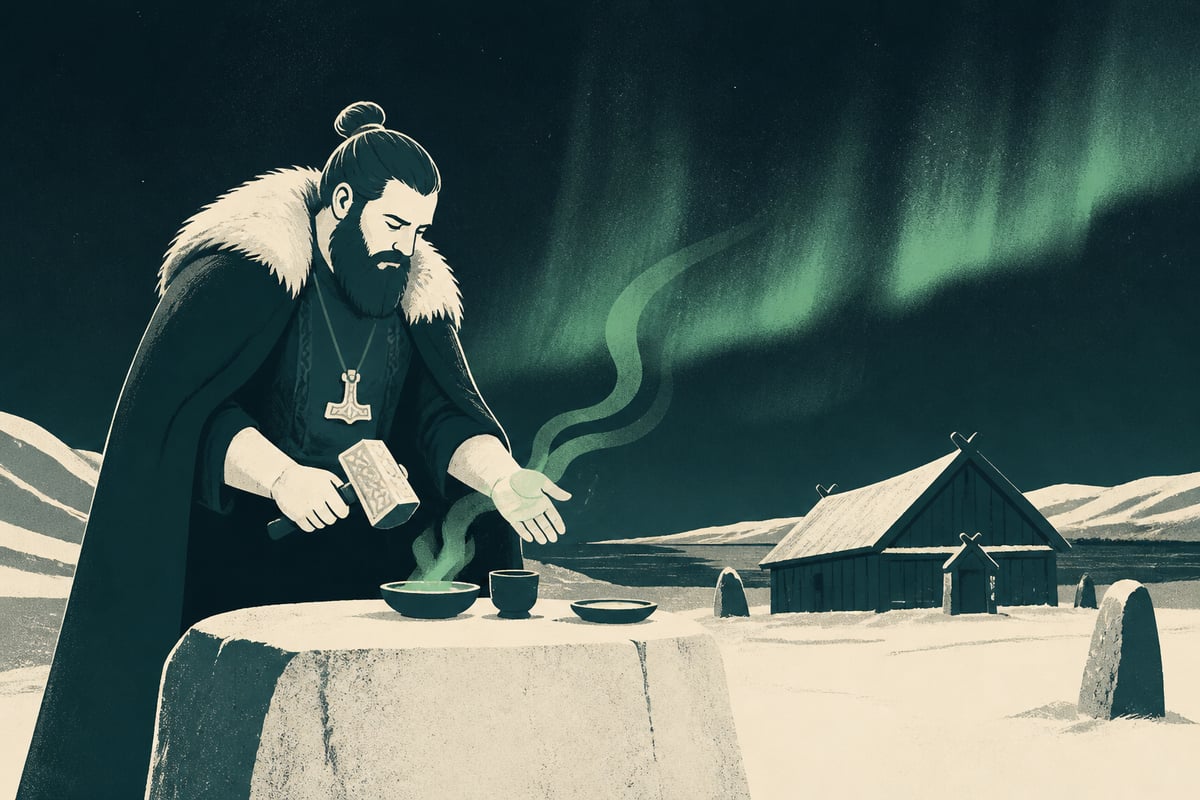
Mjölnir was both a battlefield weapon and a ritual object, used to bless marriages, births and funerals. In the Thrym story the hammer is laid in a bride's lap to sanctify the union, and other sources connect it to consecrating the dead.
Beyond the myths, Vikings wore small hammer pendants as amulets of protection. Archaeologists have found many of these across Scandinavia and the wider Viking world, often in graves. Many scholars read them as expressions of Thor's role as defender, and some see them as a response to the growing presence of Christianity, which had its own symbol worn around the neck. Some scholars note that the two kinds of pendant share similar designs.
The hammer's protective meaning also appears in the traditions that Thor guards the home and the community. Because he fights the giants who threaten human settlements, his weapon became a symbol of safety, farm fertility and good weather.
What Does Mjölnir Symbolize?
Mjölnir symbolizes protection, order and the sacred power of thunder. As Thor's weapon, it stands for the defense of gods and humans against chaos, represented in the myths by the giants.
The hammer also carries meaning beyond battle. In weddings, it stands for blessing and fertility. In funerals, it marks a boundary between life and the afterlife. Thunderstorms in Scandinavian folk belief were sometimes understood as the sound of Thor's hammer or his chariot, linking the object to rain and harvest.
For many people today, wearing a hammer pendant expresses an interest in Norse heritage, a link to nature, or a sense of strength and resilience. The Britannica Kids profile of Thor explains his role as protector and his connection to the hammer in accessible terms.
What Is the Link Between Mjölnir and the Ragnarök?
Mjölnir takes part in Ragnarök, the myth of the end of the world, where Thor fights the serpent Jormungandr. In the myths, Thor kills the serpent with the hammer and then dies from its venom. Mjölnir is then passed down to Thor's sons, Modi and Magni, who survive and inherit it in the renewed world.
Is Mjölnir in Assassin's Creed Valhalla?
Assassin's Creed Valhalla draws on Norse mythology, and its setting includes Thor and the other gods.
As with most adaptations, the game borrows from the myths without following them line by line. If you play it before visiting Iceland, you will find the original sources, the Poetic Edda and Snorri's Prose Edda, tell the stories with more humor and less fixed detail than a video game can.
How Has Mjölnir Appeared in Modern Culture?
In modern culture, Mjölnir has moved from medieval poems to comic books, films, jewelry, tattoos and video games. Popular adaptations often present it as a weapon only the worthy can lift, which is a modern invention rather than a feature of the medieval texts.
Some typical modern appearances include:
- Jewelry and tattoos: hammer pendants and designs echo Viking-age amulets
- Film and television: the hammer appears as a central prop in superhero stories
- Video games: Norse-themed games feature Thor and his hammer as characters or items
- Heritage events: reenactment groups and Norse faith communities use the hammer in ceremonies
The gap between the Norse source and its modern retellings is useful to know. When you read the original Icelandic sagas and Eddas, you meet a hammer that is practical, sacred and sometimes comic, not a puzzle about moral worth.
Where Can You Connect With Norse Myth in Iceland?
Reykjavik is a good base for engaging with Norse mythology, because Iceland preserved most of what we know about it. The Poetic Edda and Snorri's Prose Edda were written or compiled by Icelanders in the medieval period, and the landscape still carries the names and the mood of those stories.
Many visitors pair a day of museums and sights in the capital with a night outside the city lights. A Northern Lights evening is a natural fit for the theme, and the aurora has its own place in Norse imagination, linked in some retellings to the rainbow bridge Bifrost.
For help choosing between the formats, the blog has an overview of Northern Lights tours in Iceland, and a guide to what to wear on a Northern Lights tour covers the practical side. Group size and travel style matter here, so consider which format suits how you like to travel.
FAQ
What is a Mjolnir?
A Mjolnir is the hammer of the Norse god Thor, forged by dwarfs and used to defend the gods from giants. It is also a sacred object used to bless weddings and other occasions.
Why does Mjölnir have a short handle?
According to the myth, Loki disguised himself as a fly and bit the dwarfs during the forging, which caused a flaw in the handle. The result was a short haft, though the hammer remained the most powerful of the gods' treasures.
Did Vikings really wear Mjölnir pendants?
Yes. Archaeologists have found many small hammer-shaped pendants in Viking-age sites across Scandinavia, often in graves. Scholars generally read them as amulets of protection linked to Thor.