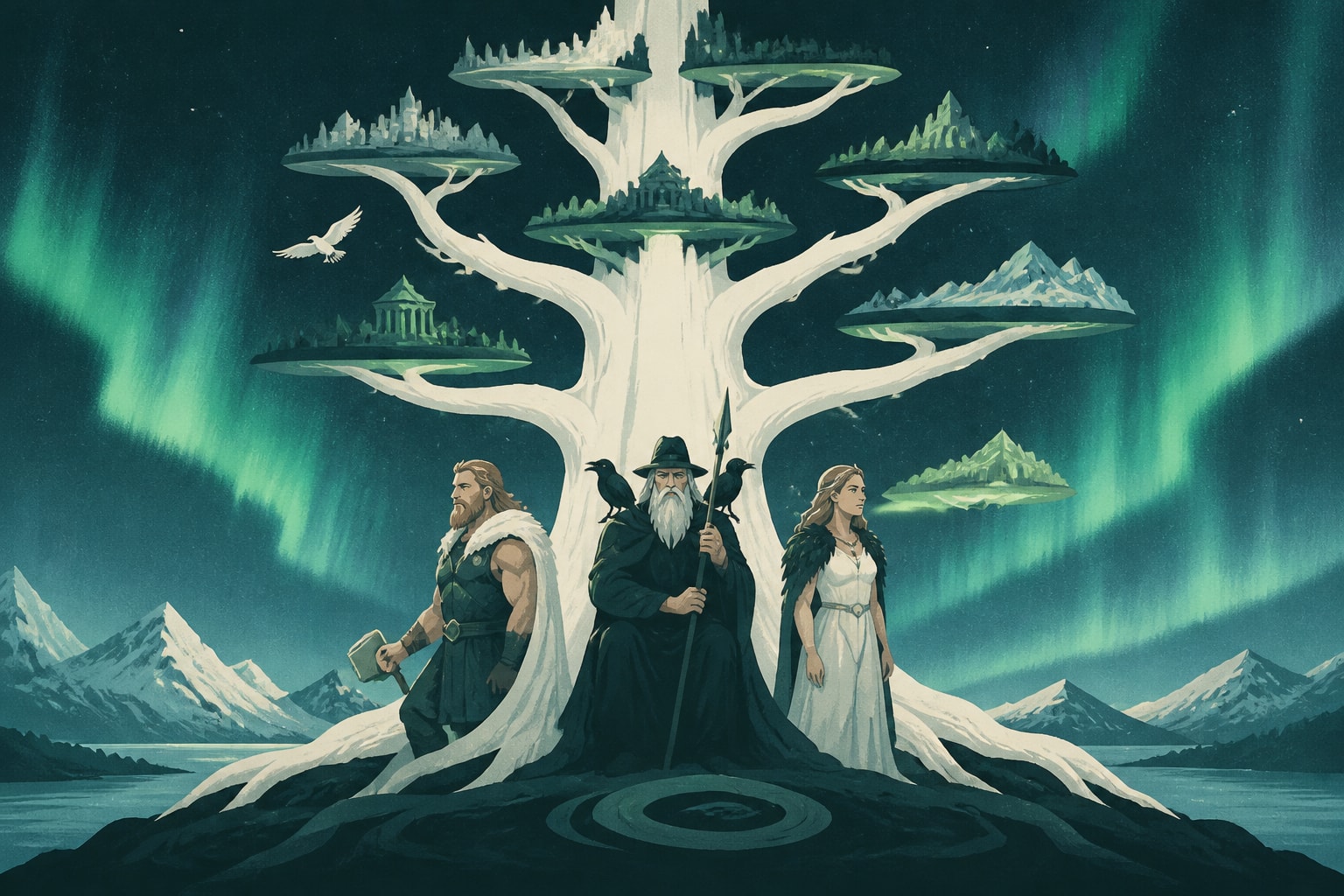
Norse mythology is the collection of myths, gods and cosmic stories that the pre-Christian peoples of Scandinavia and Iceland told about the creation of the world, the behavior of the gods and the eventual end of everything. It centers on figures such as Odin, Thor, Freyja and Loki, and on a universe of nine worlds held together by the great ash tree Yggdrasil. Most of what survives was written down in Iceland, which is why the stories remain so closely tied to the landscape visitors see there today.
What Is Norse Mythology?
Norse mythology is the body of pagan belief and storytelling held by the Norse people during and before the Viking Age, a tradition that explained nature, fate, honor and the structure of the cosmos through a family of gods and giants. The Swedish History Museum defines the Viking Age as AD 750 to 1100, a span of 350 years, while its overview of the mythological world dates it to AD 800 to 1100. The difference in dates reflects how scholars draw the boundaries of a period that did not begin or end on a single day.
These were not tidy, centrally taught doctrines. Beliefs varied by region and by household, and the myths were carried by spoken poetry long before anyone wrote them down. That oral character explains why the stories sometimes contradict one another and why the gods behave like flawed, fully drawn characters rather than distant moral ideals.
The tradition belongs to the wider family of Germanic religion, which shares figures and themes across northern Europe. Britannica's overview of Germanic religion and mythology describes how the Norse versions of Odin, Frigg, Thor, Tyr and Freyja fit into that larger picture.
How Do We Know the Myths? The Surviving Sources
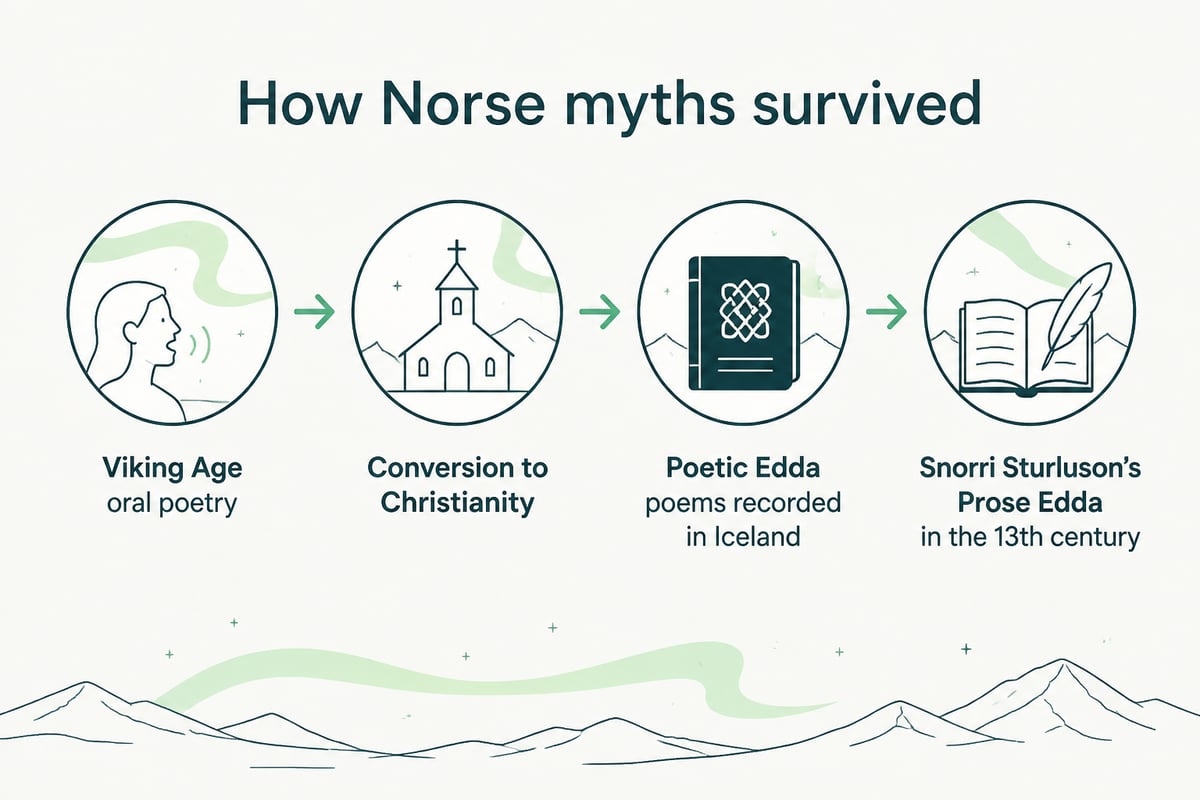
The Norse myths come down to us mainly through two Icelandic works, the Poetic Edda and the Prose Edda, both written after the Viking Age had ended. The Swedish History Museum's guide to the sources notes that the Poetic Edda is a collection of poems probably composed in western Norway and Iceland during the Viking Age. The same source explains that Snorri Sturluson wrote his Edda in the 13th century as a handbook on Norse mythology and skaldic verse.
Here is a quick comparison of the two main sources:
| Source | Form | Approximate period of writing | What it gives us |
|---|---|---|---|
| Poetic Edda | Anonymous poems | Recorded in the 13th century, composed earlier | Myths of gods and heroes in verse |
| Prose Edda | Handbook by Snorri Sturluson | 13th century | Organized retellings and a guide to poetic language |
A caution applies to both. The surviving written accounts were recorded after Christianity had largely replaced the old faith and traditions, so the authors were looking back at a world that was already fading. Snorri, a Christian, shaped his material for readers who needed to understand older poetry, and modern readers should treat his tidy narratives as a careful reconstruction rather than a verbatim record of what Viking Age people believed.
Other evidence fills in gaps. Runestones, carved images, burial finds and place names all record how ordinary people honored the gods. The Swedish History Museum says its Viking World exhibition includes 2,500 original artifacts, a reminder of how much physical evidence sits alongside the texts.
Who Are the Main Gods of Norse Mythology?
The main gods of Norse mythology are Odin, Thor, Frigg, Freyja, Freyr, Tyr, Balder and Loki, drawn from two divine families called the Aesir and the Vanir. The Aesir are the warrior and ruling gods who live in Asgard, while the Vanir are linked with fertility, prosperity and the land. The two groups once fought a war and then merged through an exchange of hostages, which is why gods such as Freyja and Freyr live among the Aesir.
- Odin is the chief of the Aesir, a god of wisdom, poetry, war and death. He traded an eye for a drink from the well of knowledge and hung himself on Yggdrasil for nine nights to learn the runes. He is the central figure in the stories of the Norse gods that Icelandic storytellers still share.
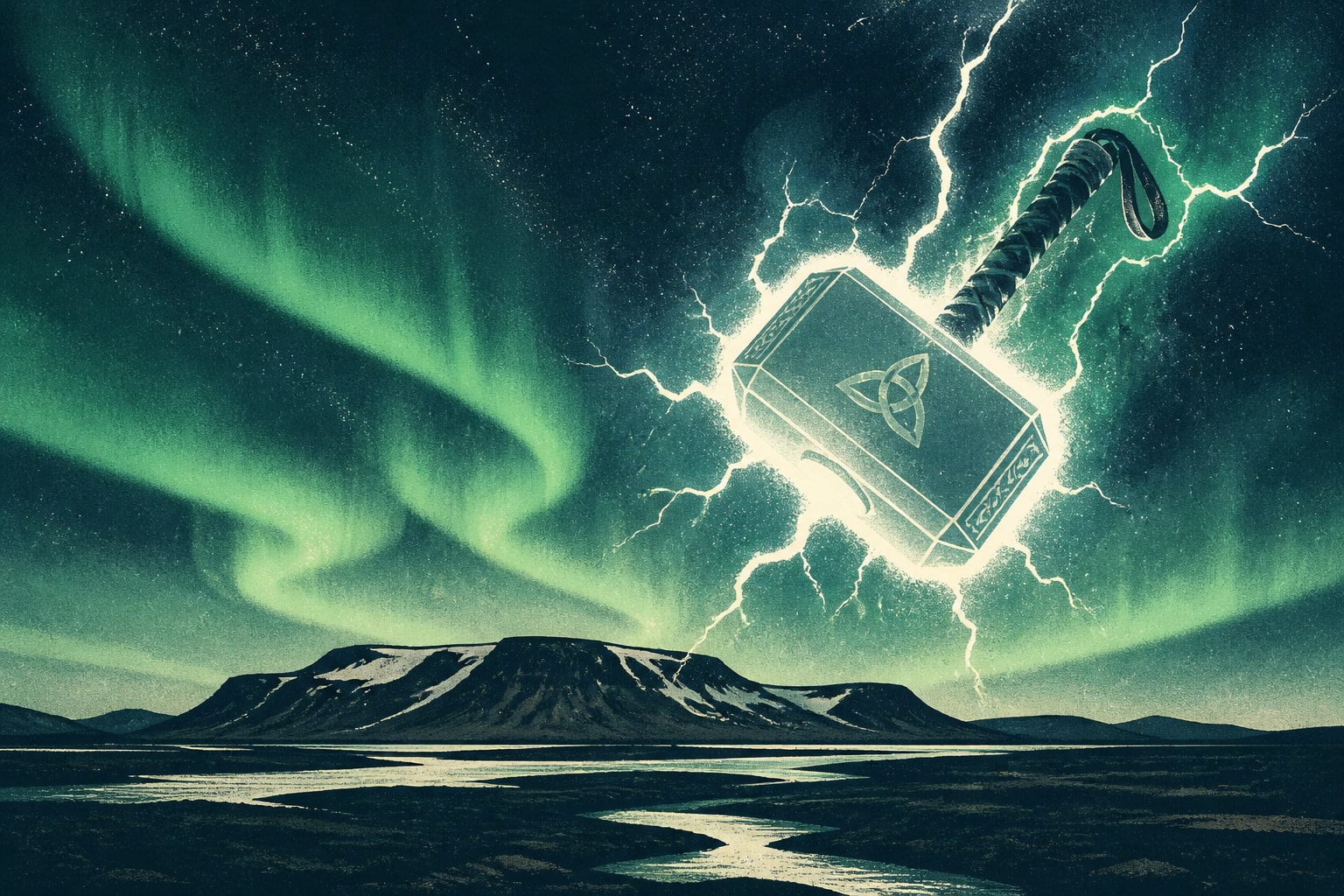
- Thor is the thunder god and protector of humankind, famous for his hammer, which gives him power over storms. Mjolnir, Thor's hammer, is one of the most recognized symbols from the whole tradition.
- Frigg is Odin's wife, associated with foresight and the household. She is said to know every fate while keeping silent about it.
- Freyja is a Vanir goddess of love, beauty and magic, who also claims half of the warriors who die in battle.
- Freyr is her brother, a god of fertility, sunshine and good harvests.
- Tyr is the god of law and war, who sacrificed his hand to bind the wolf Fenrir.
- Balder is the radiant, beloved son of Odin and Frigg, whose death starts the final chain of events.
- Loki is the shape-shifting trickster, sometimes helpful to the gods and ultimately their enemy. Loki's role in the myths is one of the richest and most contradictory in the tradition.
Giants (the jotnar) are the gods' constant rivals and, in many cases, their relatives. Dwarfs forge the gods' greatest treasures, including Thor's hammer and Odin's spear, and elves occupy a more shadowy place in the stories.
The Nine Worlds and Yggdrasil
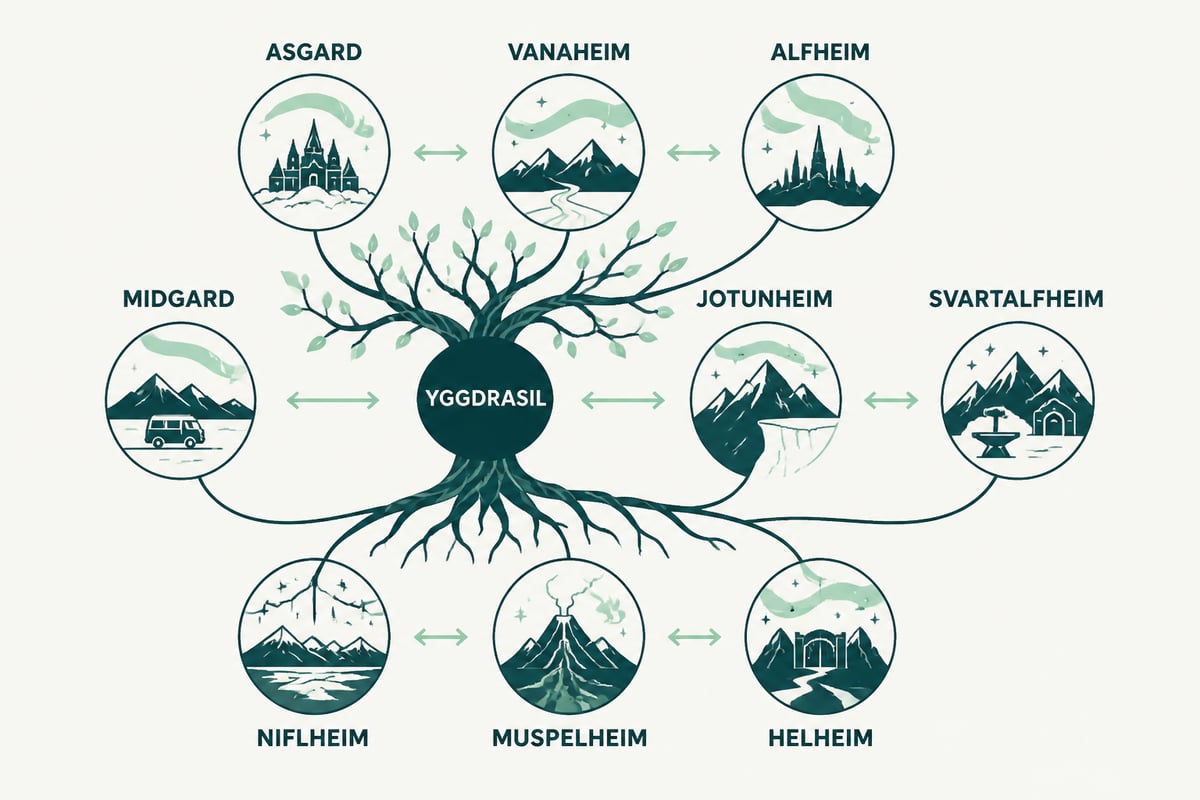
The Norse universe consists of nine worlds arranged around Yggdrasil, an enormous ash tree whose roots and branches link every realm. The Swedish History Museum describes nine mythological worlds connected by Yggdrasil, including Asgard, Vanaheim, Midgard and Jotunheim.
Some of the worlds and what they represent:
- Asgard, home of the Aesir gods, with Odin's hall Valhalla inside it.
- Vanaheim, home of the Vanir.
- Midgard, the world of humans, ringed by the sea serpent Jormungandr.
- Jotunheim, the land of the giants.
- Niflheim, a realm of ice and mist, and Muspelheim, a realm of fire. Their meeting in the void, in the myths, began creation.
- Helheim, the realm of the dead ruled by Hel.
Yggdrasil is under constant strain. A dragon gnaws at its roots, deer graze on its leaves and a squirrel carries insults up and down the trunk between an eagle and the dragon. The tree is a picture of a cosmos that holds together while always under threat, a theme that runs through every major Norse myth.
What Are Some Famous Norse Myths?
The most famous Norse myths include the creation from the body of the giant Ymir, Odin's sacrifice for wisdom, Thor's journeys among the giants, the death of Balder and the end of the world at Ragnarok. Each one shows a different side of how the Norse understood fate and courage.
The creation of the world
In the beginning there was a void between fire and ice. The meeting of the two produced the giant Ymir and a cow named Audhumla. Odin and his brothers later killed Ymir and made the earth from his flesh, the seas from his blood and the sky from his skull.
Thor and the giants
Thor's stories are often comic. In one, a giant steals his hammer and demands Freyja as his bride, so Thor dresses as a bride to get it back. In another, he visits a giant's hall and takes part in contests that turn out to be illusions, losing a drinking contest because the drinking horn was secretly connected to the sea.
The death of Balder
Balder dreams of his own death, so Frigg extracts a promise from all living things not to harm him. She overlooks the mistletoe, and Loki tricks the blind god Hodr into throwing a mistletoe dart that kills Balder. The gods' grief and Loki's punishment set the stage for the end of the world.
Ragnarok
Ragnarok is the final battle in which the gods, giants and monsters destroy one another, the sun darkens and the world sinks beneath the sea. It is not the last word, though. The myths describe a new green earth rising from the water, with a few surviving gods and two humans to repopulate it.
Is Norse Mythology Related to Greek Mythology?
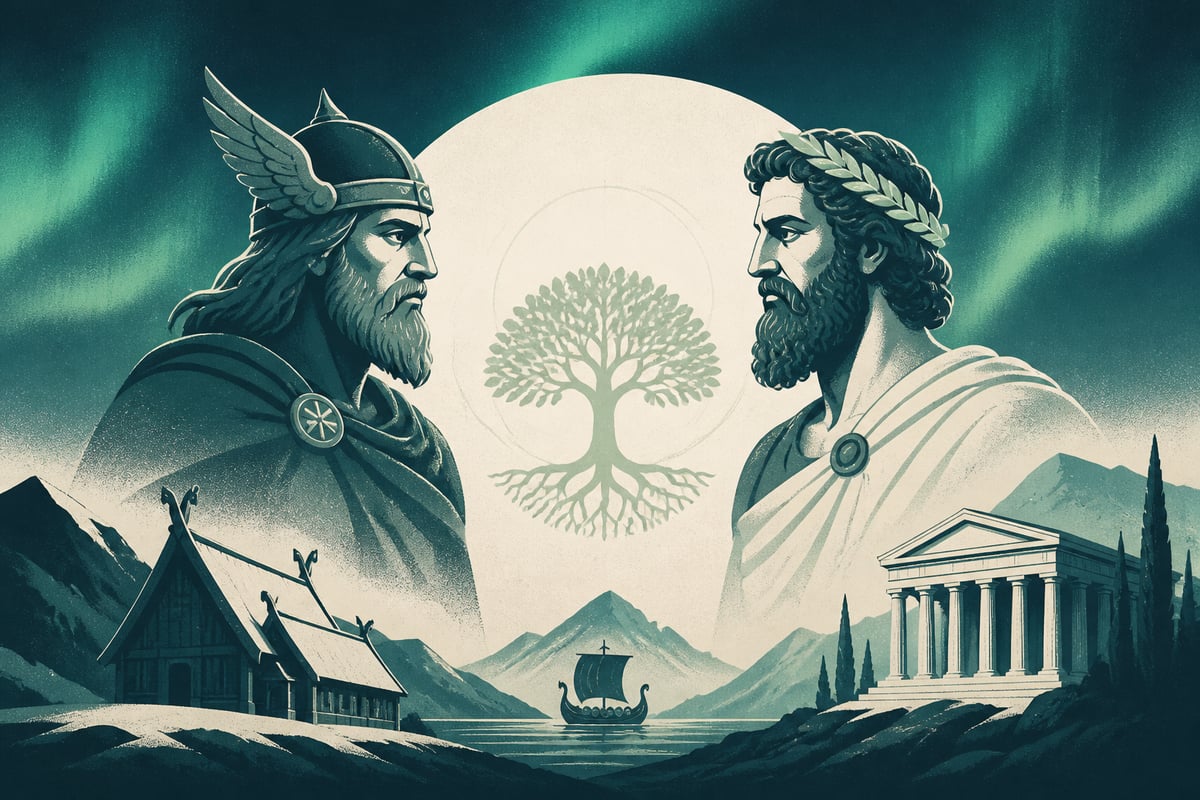
Norse mythology is not derived from Greek mythology, but the two share deep ancestral roots in the wider Indo-European tradition, which explains some parallel themes. Both feature a sky or thunder god (Thor and Zeus), a wise ruler who seeks knowledge, a trickster figure and an underworld for the dead.
The differences matter more than the overlaps. The Greek gods are largely immortal and unchanging, while the Norse gods are mortal in a sense, destined to die at Ragnarok. Fate also works differently: in the Norse tradition even Odin cannot escape what is foretold, and the heroic ideal is to meet that fate with courage rather than to avoid it. The tone of the two traditions also differs. Greek myths developed in a warm Mediterranean setting, while Norse stories reflect a harsh northern world of winter, ice and volcanic fire.
What Did the Norse Call Jesus?
The sources do not record a pre-Christian Norse name for Jesus, because Christianity entered Scandinavia from outside as the Viking Age progressed. The conversion was gradual, not sudden. The Swedish History Museum notes that by the 11th century, Christianity coexisted with local Norse customs known as sidr, meaning "custom" or "way."
Christianity spread gradually in the Norse world, and the old gods were not erased overnight. Many families continued older practices quietly, and the poets who later wrote down the myths in Iceland were Christians preserving a heritage they treated as history and literature. That mix of reverence and distance is part of why the myths survived so well.
Where Norse Mythology Lives on in Iceland
Iceland is the place where Norse mythology was written down and where it still shapes folklore and everyday storytelling. Because medieval Icelanders preserved the Eddas and the sagas, the island holds much of the surviving record of the tradition. The Swedish History Museum's summary of Old Norse myths and sagas covers the oral tradition and the later recording of these stories, along with the gods and other beings in them.
The landscape reinforces the mythology. Steaming vents, lava fields, black sand and long dark winter nights make it easy to picture Muspelheim and Niflheim as real places. Icelandic folklore also keeps older, quirkier beings alive, from the hidden elves of Iceland to the Yule Lads of the Christmas season.
FAQ
Are Norse gods still worshipped today?
Yes, in small numbers. Modern Heathenry and Asatru are revived faiths that honor the Norse gods. They are reconstructions based on the surviving medieval texts and archaeology rather than unbroken ancient practice.
What is the difference between the Aesir and the Vanir?
The Aesir are the chief gods of rule, war and wisdom, including Odin and Thor, while the Vanir are associated with fertility, wealth and the land, including Freyja and Freyr. After a war between them, the two groups made peace and exchanged hostages, which is why members of both families live together in Asgard.
Did the Vikings actually believe these myths?
Evidence from runestones, carved images, burial finds and place names suggests that Viking Age people honored the gods. Belief seems to have been practical and local rather than uniform, so the neat versions found in the Eddas should be read as literary retellings, not a single official creed.