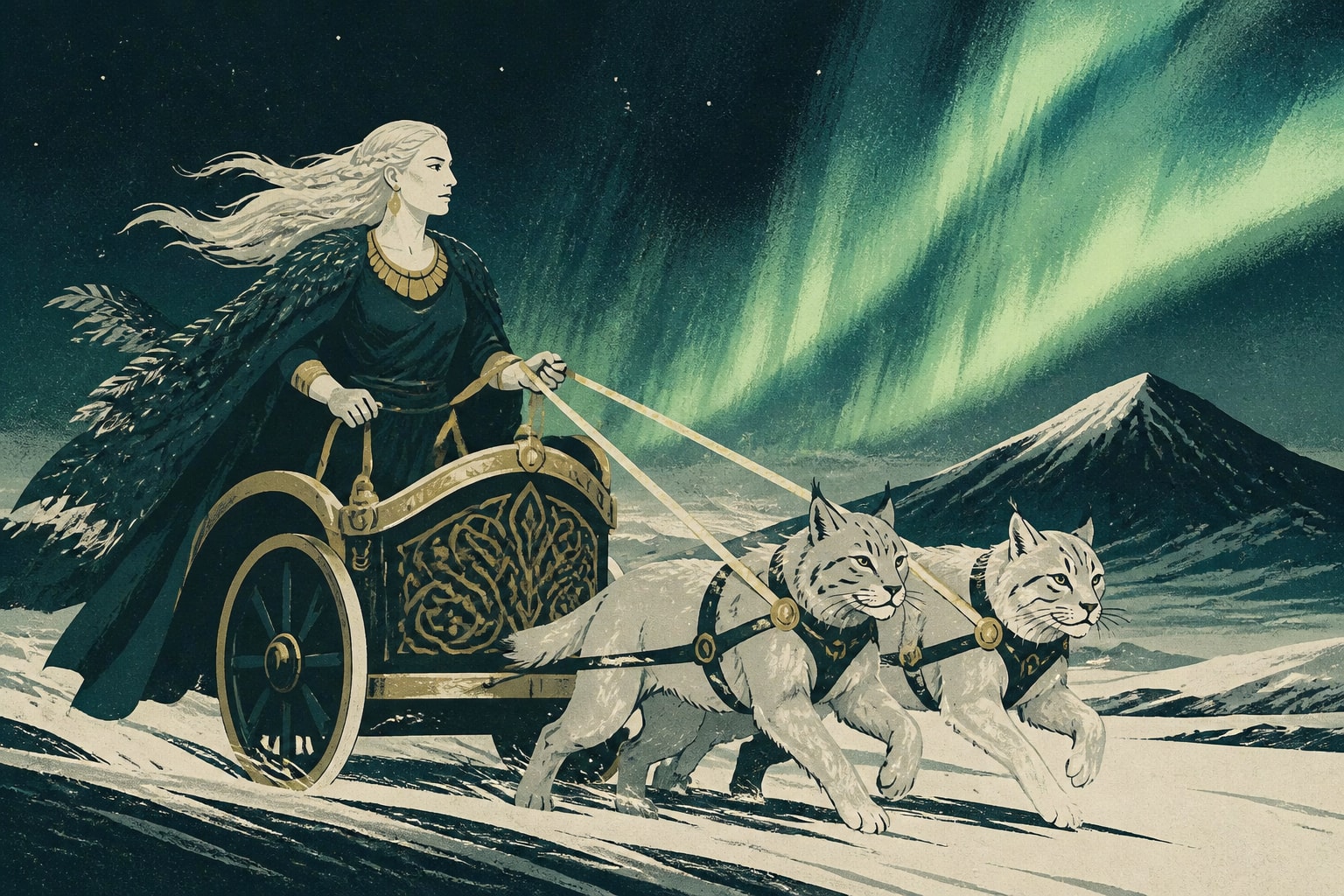
Freya Freyja is the Norse goddess of love, fertility, war, death and magic, one of the most important deities in Old Norse religion. "Freya" is the common modern English spelling and "Freyja" is the Old Norse form, so both names point to the same figure: a goddess whose name means "Lady" and who ruled over desire, wealth, battle and the afterlife.
For visitors planning an evening under the aurora in Iceland, her story is more than trivia. Icelandic culture keeps Norse mythology close to hand, and the legends told during the long winter nights often begin with figures like her.
Are Freya and Freyja the Same Goddess?
Freya and Freyja are the same goddess, and the difference lies only in spelling. Freyja is the Old Norse spelling used in medieval Icelandic texts, while Freya is the anglicized version that appears in most English-language books, films and games.
The spellings you may encounter include:
- Freyja: the scholarly and Icelandic form, with the letter j pronounced like an English y
- Freya: the standard English adaptation, easier to read and type
- Freyia, Freja, Freia: variants from other languages and older transliterations, including the Scandinavian and German forms
So if you are asking whether it is spelled Freya or Freyja, both are accepted. Academic writing and Icelandic sources favor Freyja. Popular writing favors Freya. The meaning is identical.
What Does the Name Freyja Mean?
The name Freyja is Old Norse for "Lady," according to Encyclopaedia Britannica. It works as a title of rank as much as a personal name, which suggests she held a position of real authority among the gods.
Her brother's name follows the same pattern. Freyr means "Lord," and the siblings form a matched pair of "Lord" and "Lady." That symmetry hints at an older tradition in which these two stood at the head of a distinct divine family, the Vanir.
Who Were Freyja's Family?
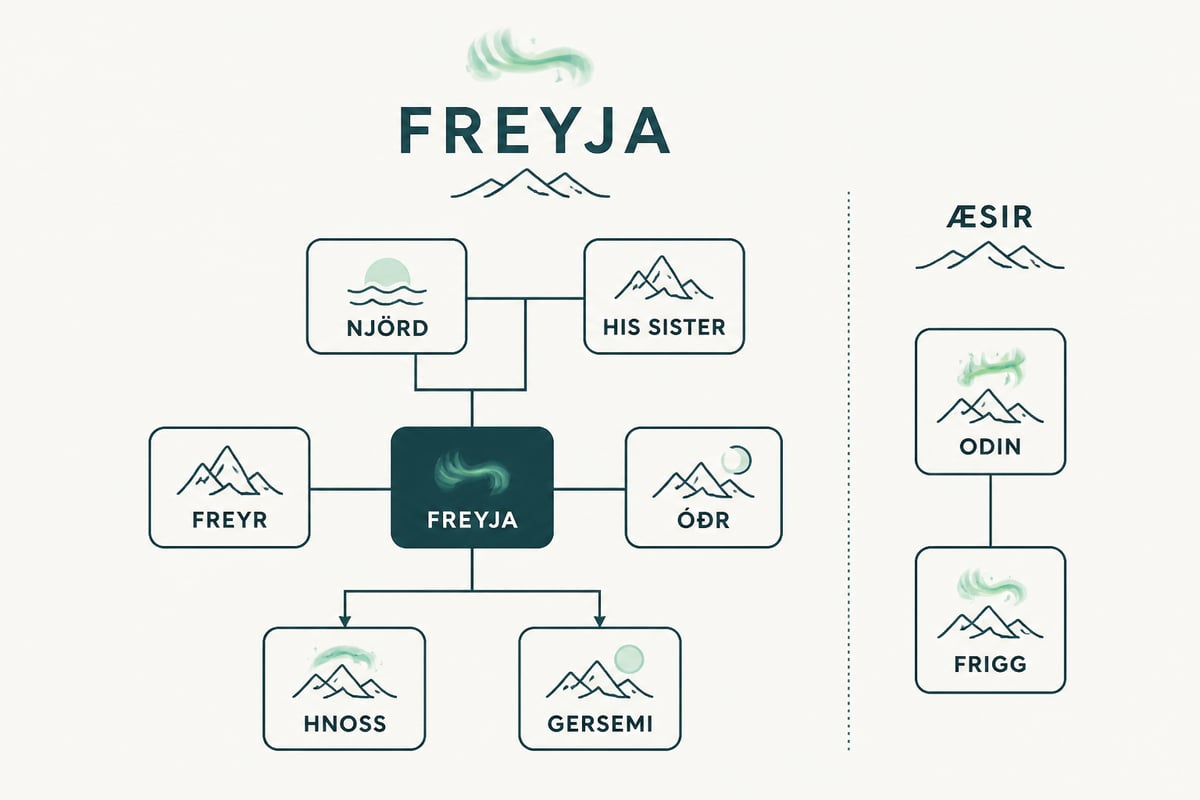
Freyja is the daughter of Njörd and the sister of Freyr, according to Britannica. All three belong to the Vanir, the group of gods linked with fertility, prosperity and the natural world, as opposed to the warrior-focused Æsir led by Odin.
A few details about her household are worth knowing:
- Parents: Njörd, god of the sea and wind, and, in some accounts, his sister, whose name is not recorded
- Brother: Freyr, god of sunlight, harvests and peace, whose role is outlined in Britannica's entry on Freyr
- Husband: Óðr, a mysterious figure who wanders away, leaving Freyja to weep tears of red gold
- Daughters: Hnoss and Gersemi, whose names both relate to treasure and precious things
Her relationship to the Æsir came through the Æsir-Vanir war, which ended in an exchange of hostages. Njörd and his children went to live among the Æsir, which is how Freyja ended up in Asgard with a hall of her own.
Is Odin's Wife Frigg or Freya?
Odin's wife is Frigg, not Freyja. Frigg is the queen of the Æsir and the goddess of marriage, foresight and motherhood, while Freyja is a separate goddess from the Vanir who was never married to Odin.
The confusion has a real source. The two names are close in sound, both goddesses are tied to love and fertility, and some Germanic traditions may have blended aspects of them. In the Norse sources, though, they are distinct. Friday takes its English name from Frigg's Germanic counterpart in most scholarship, though some traditions connect it to Freyja.
If you want to understand the god at the center of that family tree, the story of Odin explains how he gained wisdom, why he sacrificed an eye, and where Frigg fits beside him.
What Is Freyja the Goddess Of?
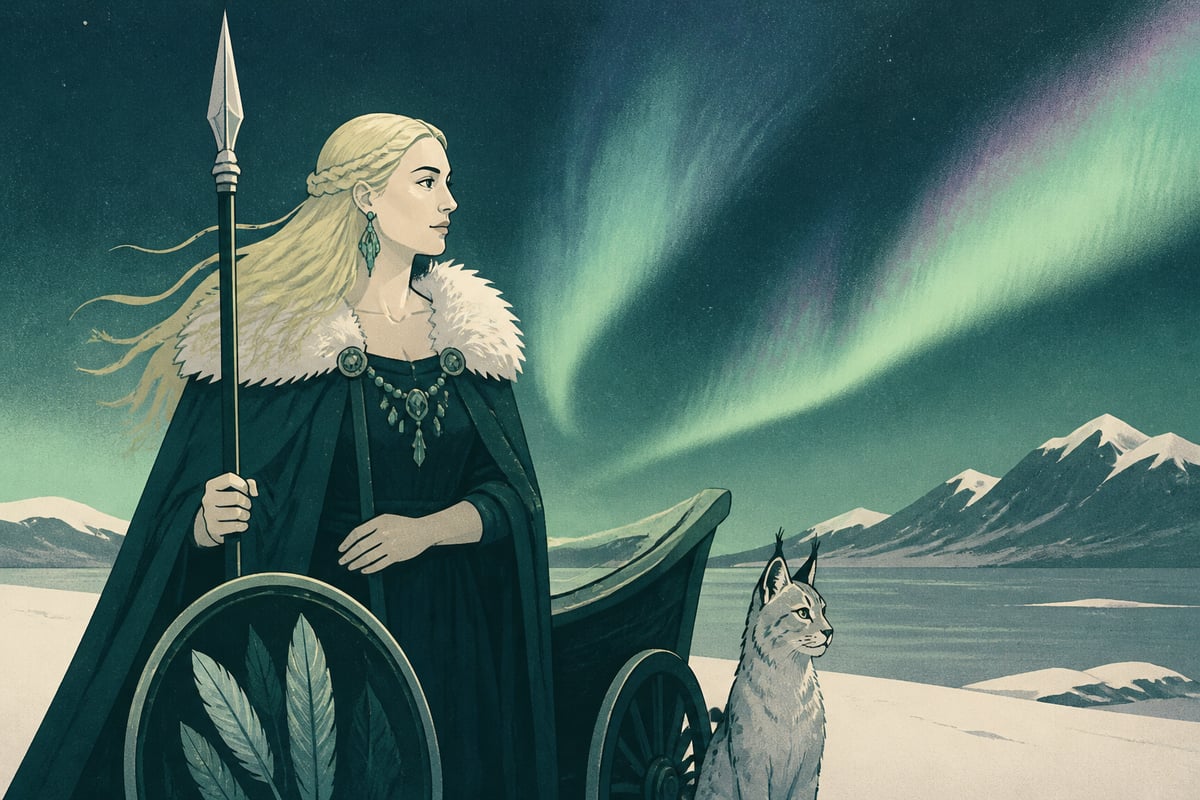
Freyja is associated with love, fertility, battle and death, as Britannica summarizes, and she is also tied to magic. This blend of desire and violence can seem surprising, but it reflects how Viking Age people understood the cycle of life and loss.
Her main domains break down this way:
- Love and desire. Poems and charms called on her for matters of the heart, and she is the figure most often credited with human attraction.
- Fertility and abundance. Together with her brother Freyr, she was connected to good harvests, healthy births and prosperity.
- War and death. According to the poem Grímnismál, she receives half of those who die in battle in her hall Fólkvangr, while Odin takes the other half to Valhalla.
- Magic. She is linked with seiðr, a form of magic involving prophecy and fate.
The Swedish History Museum notes that Freyja is associated with seiðr and is said to have taught it to Odin, which makes her one of the most significant magical figures in the tradition. You can read more in its overview of Freyja.
What Are Freyja's Symbols and Possessions?
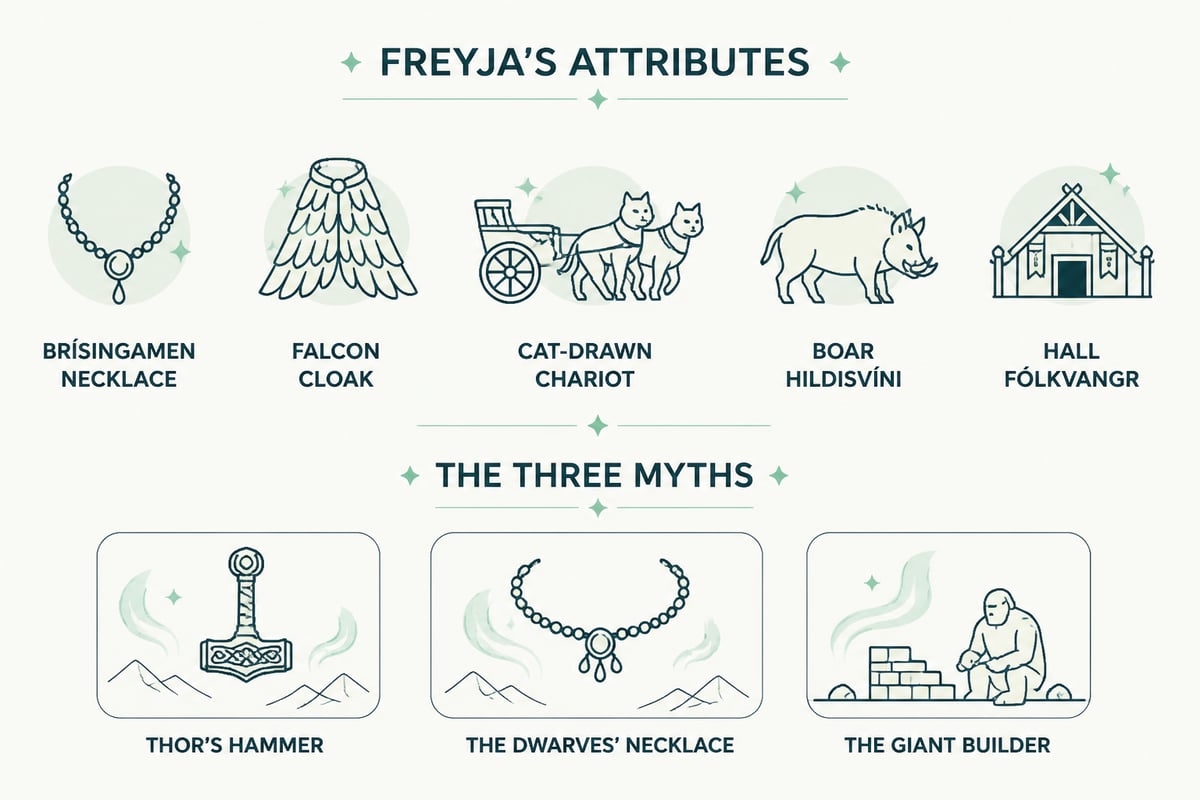
Freyja's best-known possessions are a golden necklace, a cloak of falcon feathers and a chariot pulled by cats. Each object appears in the surviving myths and gives scholars a way to understand how she was pictured.
| Symbol | Meaning or role |
|---|---|
| Brísingamen | A gleaming necklace, said to have been made by dwarves, linked to beauty and desire |
| Falcon cloak | A feather garment that lets the wearer fly; Freyja lends it to others in the myths |
| Cat-drawn chariot | Her mode of travel, with cats as symbols of independence and fertility |
| Hildisvíni | A boar whose name means "battle swine," her companion in some poems |
| Fólkvangr | Her hall, where she welcomes half of the battle dead |
The boar and the cats show how she bridges the domestic and the wild. Her animals are tied to both the farm and the battlefield, which fits a goddess who governs both growth and endings.
Which Myths Feature Freyja?
The most famous myths about Freyja involve a stolen hammer, a giant's demand for her hand, and the price of her necklace. These stories, preserved mainly in the Poetic Edda and the Prose Edda by the Icelandic writer Snorri Sturluson, show her as strong-willed and unwilling to be bargained over.
The Theft of Thor's Hammer
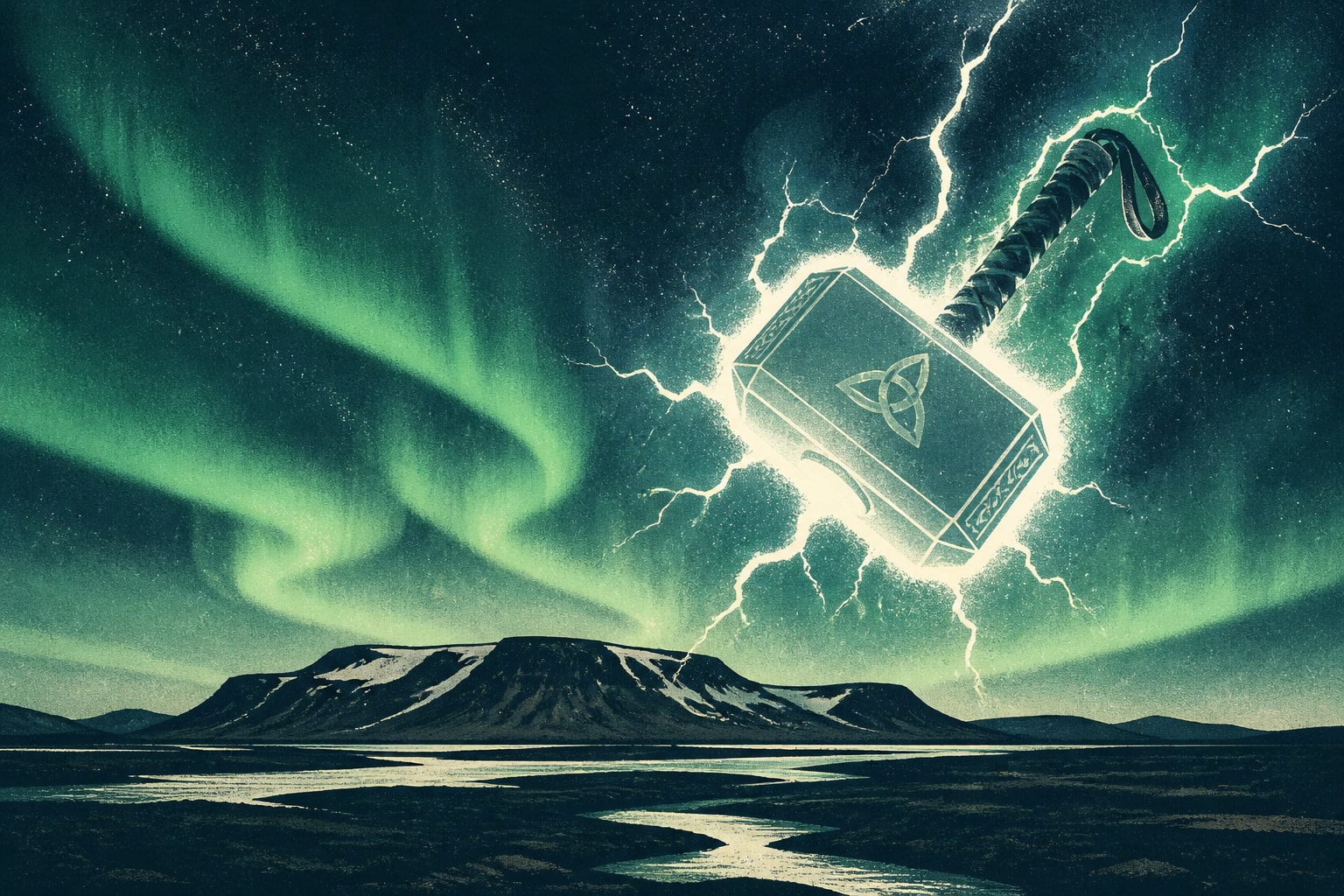
In Þrymskviða, a giant steals Mjölnir and demands Freyja as his bride in exchange. She refuses so furiously that her necklace snaps. The gods instead dress Thor in bridal clothing to recover the hammer, a comic episode that also shows Freyja's refusal to be treated as payment.
The Necklace and the Dwarves
In one tradition, Freyja acquires Brísingamen from four dwarf smiths. The price, according to the later account, is a night with each of them. The story is a reminder that the sources were written down centuries after the pagan period, often by Christian authors, and their tone toward her is not always neutral.
The Giant Builder
In another tale, a giant offers to build a wall around Asgard in exchange for the sun, the moon and Freyja herself. The gods agree under conditions meant to make the task impossible. The giant nearly succeeds before Loki intervenes, and the bargain collapses.
For a wider picture of how these tales fit together, the guide to Norse gods maps the major deities and their relationships.
Is Freyja a Real Norse Goddess?
Freyja was a real goddess in the sense that people in Viking Age Scandinavia and Iceland worshipped her, though she is a figure of religion and myth rather than a historical person. She is not a fictional creation of modern fantasy, and evidence for her cult runs across several centuries.
That evidence includes:
- Place names: Many locations in Sweden and Norway incorporate her name, suggesting local worship
- Personal names: Names built from her title appear in the historical record
- Written sources: The Eddas, skaldic poetry and sagas mention her repeatedly
- Museum interpretation: The Norwegian Museum of Cultural History presents her among the Viking mythological figures in its Midgardr exhibition, alongside her links to love, fertility, death and magic
Scholars still debate how much of the surviving material reflects genuine pagan belief and how much was shaped by later writers. What is clear is that she was among the most widely honored goddesses in the Norse world.
How Does Freyja Connect to Iceland Today?
Freyja lives on in Iceland through its literature, place names and the habit of telling old stories in the dark months. Iceland is where most of the written Norse mythology was preserved, and the island's relationship to these tales remains unusually direct.
Many of the myths feel most alive in the setting where they were once told: long nights, open landscapes and skies that shift color. The Icelandic word for the aurora has no ancient link to Freyja, but the tradition of explaining the sky through gods and legends is old. The story of Bifröst, the burning rainbow bridge between worlds, is one example visitors often connect to the lights overhead.
If your interest in Freyja is part of a wider curiosity about Icelandic folklore, the accounts of elves in Iceland and the end-of-the-world tale of Ragnarök show how deeply these beliefs run.
Telling Norse Stories on a Northern Lights Evening
Local guides plan viewing stops around live sky conditions, which means the evening follows the sky rather than a fixed script. Warm drinks help make the waiting between sightings more comfortable. No operator can promise a sighting, because the aurora depends on solar activity and clear skies.
For couples and small groups who prefer a more personal evening, the smaller formats put you closer to the guide and the conversation. With more than 10 years of experience, the team has plenty of practice at reading conditions and choosing the right stop. To plan your timing, the guide to the best time for the northern lights in Reykjavik is a useful starting point.
FAQ
Is Freya a real Norse god?
Freyja is a goddess rather than a god, and she was genuinely worshipped in the Viking Age. Her cult is supported by place names, personal names and medieval Icelandic texts, though the myths themselves are religious stories rather than history.
Why is Freyja linked to both love and war?
In Norse belief, desire, fertility, battle and death were parts of one cycle rather than opposites. Freyja governs the life-giving side through love and abundance and the closing side by receiving half of the battle dead in her hall Fólkvangr.
Did Freyja teach Odin magic?
According to the Swedish History Museum, Freyja is associated with seiðr and is said to have taught it to Odin. This detail positions her as a source of knowledge that even the chief of the Æsir sought out.